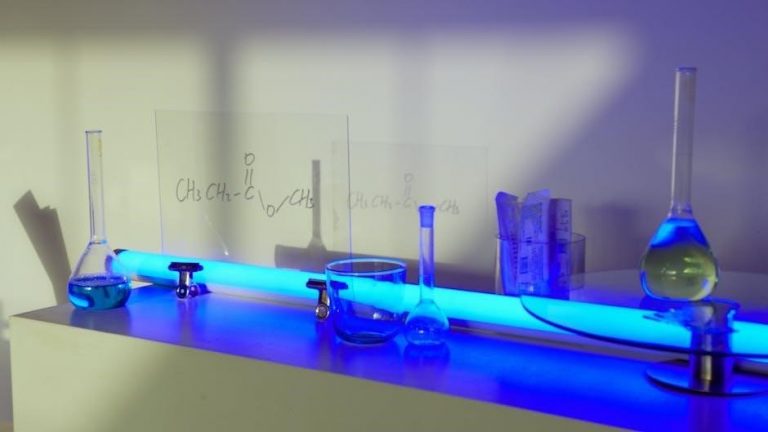
This manual‚ designed for introductory chemistry courses‚ provides a hands-on learning experience. It complements textbook concepts with practical experiments‚ fostering a deeper understanding of chemical principles.
Purpose of the Lab Manual
This lab manual’s core purpose is to bridge theoretical knowledge with practical application‚ enhancing comprehension of general chemistry principles. It aims to develop essential laboratory skills – measurement‚ observation‚ and data analysis – crucial for scientific inquiry. Each experiment is carefully selected to align with textbook material‚ reinforcing concepts through hands-on experience.
Furthermore‚ the manual fosters critical thinking and problem-solving abilities‚ preparing students for advanced studies and careers in science. Pre-lab exercises and report forms encourage thorough preparation and thoughtful interpretation of results‚ promoting a deeper understanding of chemical phenomena.
Safety Procedures in the Chemistry Lab
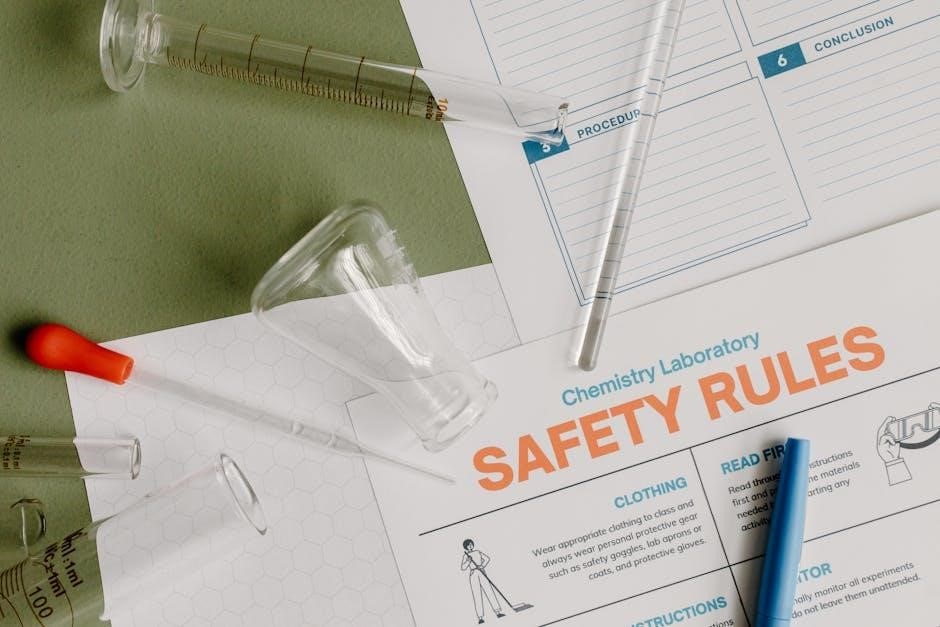
Prioritizing safety is paramount in the chemistry lab. Students must adhere strictly to all outlined procedures to prevent accidents and ensure a secure learning environment. This includes wearing appropriate personal protective equipment (PPE) – safety goggles‚ gloves‚ and lab coats – at all times.
Proper handling and disposal of chemicals are crucial; never pipette by mouth and always follow waste disposal guidelines. Familiarize yourself with the location of safety equipment‚ such as fire extinguishers and eyewash stations. Report any spills or accidents immediately to the instructor.
Essential Lab Equipment and Their Uses
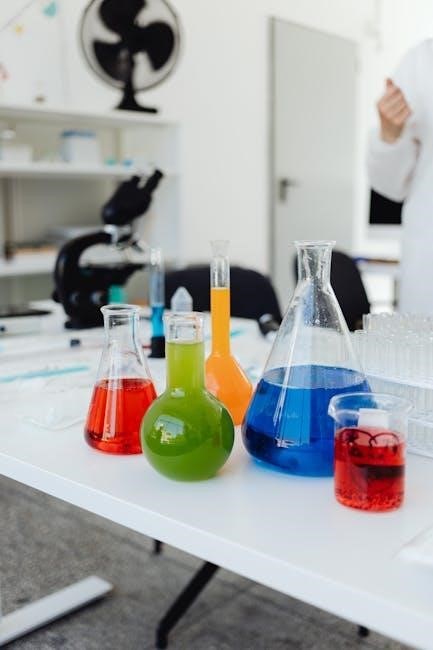
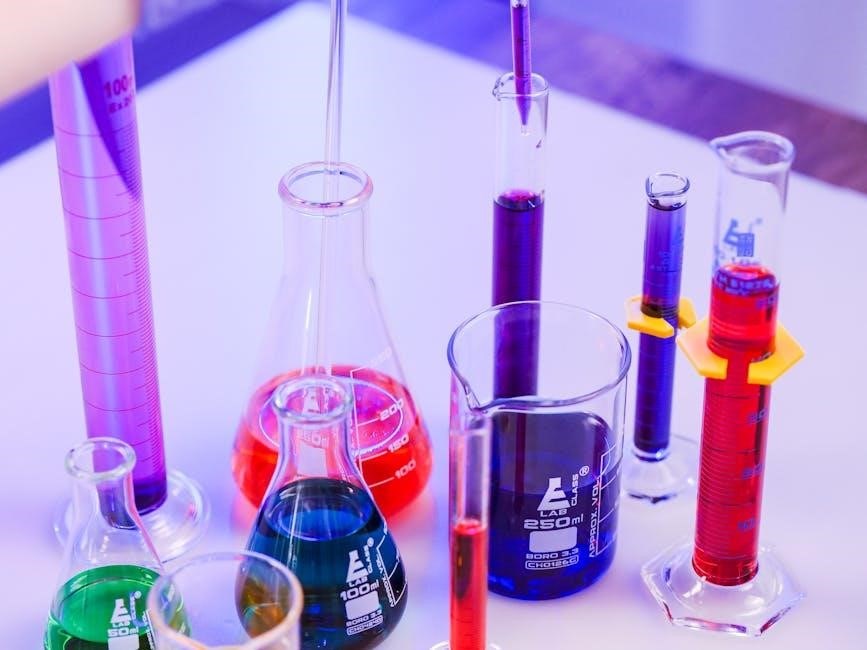
A well-equipped chemistry lab features various tools for accurate experimentation. Beakers are used for holding and mixing liquids‚ while Erlenmeyer flasks offer better mixing due to their conical shape. Bunsen burners provide controlled heat‚ and hot plates offer a safer alternative.
Volumetric glassware – pipettes and burettes – delivers precise volumes. Balances measure mass accurately‚ and spectrophotometers analyze light absorption. Understanding the function of each instrument is vital for successful and reliable results.
Basic Laboratory Techniques
Mastering fundamental skills like precise measurements‚ safe heating‚ and proper filtration are crucial for conducting experiments effectively and obtaining reliable data.
Measurement Techniques: Accuracy and Precision
Understanding the difference between accuracy and precision is paramount in any chemistry laboratory setting. Accuracy refers to how closely a measured value aligns with the true or accepted value‚ while precision indicates the repeatability of a measurement.
Students will learn to utilize various instruments – balances‚ graduated cylinders‚ burettes – and assess potential errors. Proper technique‚ including reading measurements at the meniscus and understanding significant figures‚ directly impacts data quality.
This section emphasizes minimizing both random and systematic errors to ensure reliable experimental results and meaningful conclusions. Practicing these skills builds a strong foundation for future laboratory work.
Using Volumetric Glassware
Volumetric glassware – pipettes‚ burettes‚ and volumetric flasks – delivers precise volumes of liquids‚ crucial for quantitative analysis. Proper usage requires understanding their specific designs and limitations. Students will learn techniques for accurate filling‚ draining‚ and rinsing to minimize errors.
Emphasis is placed on reading the meniscus correctly‚ ensuring proper temperature calibration‚ and avoiding parallax errors. Careful handling is essential‚ as these instruments are fragile and require gentle cleaning.
Mastering volumetric glassware skills is fundamental for accurate solution preparation and titrations‚ leading to reliable experimental outcomes.
Filtration and Decantation
Filtration separates solid particles from liquids using filter paper and a funnel‚ while decantation carefully pours off a liquid‚ leaving a solid residue. These techniques are essential for purifying products and isolating precipitates. Students will practice proper filter paper folding and wetting to ensure efficient separation.
Techniques include gravity filtration and vacuum filtration‚ each suited for different particle sizes and volumes. Care must be taken to avoid losing product during transfer and rinsing.
Understanding these separation methods is vital for obtaining pure compounds and analyzing reaction mixtures.
Heating and Cooling Techniques
Safe and controlled heating and cooling are crucial in chemistry. Techniques include using Bunsen burners‚ hot plates‚ and ice baths. Students will learn proper methods for heating liquids‚ preventing bumping with boiling chips‚ and safely handling hot glassware.
Cooling involves ice baths or controlled-temperature water baths to slow reactions or crystallize products. Precautions against thermal shock are emphasized when heating or cooling glassware.
Mastering these skills ensures accurate experimental results and minimizes hazards in the laboratory setting.
Experiments Based on Physical Properties
This section explores measurable characteristics of matter – density‚ melting/boiling points‚ and separation via chromatography – providing foundational experimental skills.
Experiment 1: Density Determination
This experiment introduces a fundamental physical property: density‚ defined as mass per unit volume. Students will determine the density of solids and liquids using precise measurement techniques. The procedure involves accurately measuring mass using balances and volume using graduated cylinders or volumetric glassware.
Calculations require careful attention to significant figures and units. Error analysis will be discussed‚ considering potential sources of inaccuracy in measurements. Understanding density is crucial for identifying substances and predicting their behavior in various mixtures and solutions‚ laying groundwork for further studies.
Experiment 2: Melting and Boiling Point Analysis
This experiment focuses on characterizing substances by their melting and boiling points – intensive physical properties. Students will determine these temperatures for known and unknown compounds‚ utilizing appropriate heating techniques and careful observation. Melting point determination involves observing the phase transition from solid to liquid‚ while boiling point analysis examines the liquid-to-gas transition.
Purity assessment is a key aspect‚ as sharp melting/boiling points indicate higher purity. Comparisons to literature values will be made‚ and potential errors due to heating rate or thermometer calibration will be discussed.
Experiment 3: Chromatography – Separation Techniques
This experiment introduces chromatography‚ a powerful technique for separating mixtures based on differing component affinities. Students will explore various chromatographic methods‚ potentially including thin-layer chromatography (TLC) or column chromatography. The principle relies on a stationary phase and a mobile phase‚ causing components to migrate at different rates.
Rf values will be calculated in TLC to identify substances‚ and the effectiveness of separation will be analyzed. Applications in analytical chemistry and purification will be discussed‚ highlighting the technique’s versatility.
Stoichiometry and Chemical Reactions
This section focuses on quantitative relationships in chemical reactions‚ utilizing experiments to determine formula masses and analyze reaction types for precise results.
Experiment 4: Determining the Formula of a Hydrated Salt
This experiment guides students through the process of experimentally determining the formula of a hydrated salt. Students will accurately measure the mass of the hydrated salt before and after heating to remove the water molecules. By calculating the mass of water lost‚ and subsequently the moles of water‚ they can determine the ratio of water to anhydrous salt.
Careful heating and precise mass measurements are crucial for accurate results. The determined ratio will then be used to write the correct empirical formula for the hydrated salt‚ reinforcing stoichiometric principles and experimental technique.
Experiment 5: Formula Mass of a Compound
This experiment focuses on determining the formula mass (also known as molecular weight) of an unknown compound. Students will utilize principles of stoichiometry and molar mass calculations‚ employing a known chemical reaction to indirectly find the formula mass. The process involves reacting a known mass of the compound with another reactant.
By carefully measuring the mass of the product formed‚ and understanding the reaction’s stoichiometry‚ students can calculate the formula mass of the original unknown compound‚ solidifying their understanding of molar concepts.
Experiment 6: Types of Chemical Reactions
This experiment aims to identify and classify various types of chemical reactions‚ including synthesis‚ decomposition‚ single replacement‚ and double replacement reactions. Students will observe visual cues – such as color changes‚ gas evolution‚ or precipitate formation – to determine the reaction type.
Through a series of carefully selected reactions‚ students will practice writing balanced chemical equations and predicting products‚ reinforcing their understanding of fundamental chemical principles and reaction patterns.
Solutions and Aqueous Systems
This section explores solution chemistry‚ focusing on concepts like molarity‚ dilution‚ and conductivity. Experiments investigate how solutes interact with solvents‚ impacting observable properties.
Experiment 7: Electrical Conductivity of Aqueous Solutions
This experiment investigates the ability of various aqueous solutions to conduct electricity. Students will measure conductivity using appropriate equipment‚ correlating observations with the presence of ions. Solutions of ionic compounds‚ covalent compounds‚ and acids/bases will be tested. The lab emphasizes the relationship between solution composition and electrical properties‚ demonstrating how electrolytes facilitate charge transport. Data analysis will involve comparing conductivity values and explaining differences based on molecular structure and dissociation. Safety precautions regarding electrical equipment are paramount‚ and proper waste disposal procedures must be followed. Understanding these principles is crucial for numerous applications in chemistry and related fields.
Experiment 8: Molarity and Dilution Calculations
This lab focuses on mastering molarity calculations and the principles of dilution. Students will prepare solutions of specific molar concentrations‚ utilizing accurate weighing and volumetric techniques. Serial dilutions will be performed to demonstrate the relationship between concentrated stock solutions and diluted working solutions. Calculations will verify the accuracy of prepared solutions‚ reinforcing understanding of the dilution equation (M1V1 = M2V2). Emphasis is placed on precise measurements and proper laboratory technique. Safety includes handling chemicals and glassware carefully. Accurate concentration determination is vital for subsequent experiments.
Experiment 9: Titration and Acid-Base Chemistry
This experiment introduces students to acid-base titrations‚ a fundamental analytical technique. Students will standardize a base solution using a primary standard acid‚ determining its precise concentration. Then‚ they’ll titrate an unknown acid solution‚ calculating its molarity. The endpoint will be determined using an appropriate indicator‚ observing the color change. Calculations will involve stoichiometry and the titration equation. Proper technique‚ including careful observation and accurate volume measurements‚ is crucial. Safety precautions regarding acid handling are paramount. Understanding equivalence points is key.
Gas Laws and Kinetic Molecular Theory
This section explores relationships between pressure‚ volume‚ and temperature of gases. Experiments verify Boyle’s and Charles’s Laws‚ illustrating the kinetic molecular theory’s principles.
Experiment 10: Boyle’s Law – Pressure and Volume Relationship
This experiment investigates the inverse relationship between the pressure and volume of a gas‚ keeping temperature constant. Students will utilize a gas syringe and varying weights to alter pressure‚ meticulously recording volume changes. Data analysis involves plotting pressure versus volume‚ confirming Boyle’s Law’s proportionality.
Precise measurements and careful observation are crucial for accurate results. The lab emphasizes understanding how gas behavior changes under different conditions‚ solidifying the kinetic molecular theory. Calculations will determine the constant ‘k’ in the equation PV = k‚ validating the law experimentally.
Experiment 11: Charles’s Law – Volume and Temperature Relationship
This lab explores Charles’s Law‚ demonstrating the direct proportionality between a gas’s volume and absolute temperature at constant pressure. Students will heat a gas sample‚ carefully measuring volume changes at different temperature intervals using a gas syringe immersed in water baths.
Data analysis involves plotting volume against temperature (in Kelvin) to verify the linear relationship. Precise temperature control and accurate volume readings are vital for reliable results. The experiment reinforces understanding of the kinetic molecular theory and gas behavior.
Thermochemistry
This section investigates heat changes in chemical reactions using calorimetry. Students will measure temperature variations to determine enthalpy changes for various processes.
Experiment 12: Calorimetry and Heat of Reaction
This experiment focuses on applying calorimetry principles to determine the heat absorbed or released during a chemical reaction. Students will utilize a calorimeter to measure temperature changes‚ carefully observing the reaction between two solutions. Data analysis will involve calculating the heat of reaction (ΔH) using specific heat capacity and mass measurements.
Precise temperature readings and accurate mass determinations are crucial for obtaining reliable results. The lab emphasizes understanding exothermic and endothermic processes‚ linking theoretical concepts to practical application. Safety precautions regarding handling chemicals and glassware will be strictly enforced throughout the procedure.
Qualitative Analysis
This section introduces techniques for identifying substances based on their chemical properties‚ utilizing tests to detect the presence of specific ions in solution.
Experiment 13: Identifying Common Ions
This experiment focuses on developing skills in qualitative analysis‚ specifically identifying common ions present in aqueous solutions. Students will employ a series of precipitation reactions and observations to determine the presence of cations and anions. Careful observation of color changes‚ precipitate formation‚ and solubility characteristics are crucial for accurate identification. The procedure involves systematically testing unknown solutions against known reagents‚ utilizing solubility rules to predict outcomes. Proper waste disposal is essential‚ adhering to established laboratory protocols for chemical waste management. Successful completion requires meticulous technique and a thorough understanding of ionic interactions.
Spectroscopy
Spectrophotometry introduces students to the interaction between light and matter‚ analyzing substances based on their unique absorption or emission spectra for identification.
This experiment familiarizes students with spectrophotometry‚ a crucial analytical technique. Students will learn how a spectrophotometer measures the absorbance and transmittance of light through a solution. The goal is to understand the relationship between concentration and absorbance‚ governed by Beer-Lambert’s Law. Practical application involves creating a calibration curve using known concentrations of a colored compound. Students will then determine the unknown concentration of a sample using this established curve‚ gaining valuable skills in quantitative analysis and understanding how light interacts with chemical species.
Environmental Chemistry
This section explores chemistry’s role in environmental issues‚ focusing on water quality analysis and pollutant identification through practical experiments and data interpretation.
Experiment 15: Water Quality Analysis
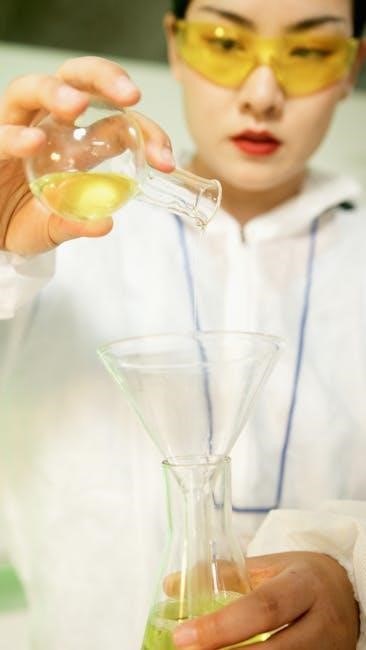
This experiment investigates crucial parameters for assessing water potability and environmental health. Students will measure pH‚ dissolved oxygen‚ turbidity‚ and conductivity using appropriate instrumentation. Analysis includes identifying common pollutants and their impact on aquatic ecosystems. Data collected will be compared against established water quality standards‚ fostering critical thinking about environmental regulations. Furthermore‚ students will learn about various water treatment methods and their effectiveness in removing contaminants. The lab emphasizes the importance of responsible water resource management and the role of chemistry in safeguarding our environment. Proper waste disposal procedures are paramount throughout this investigation.
Data Analysis and Reporting
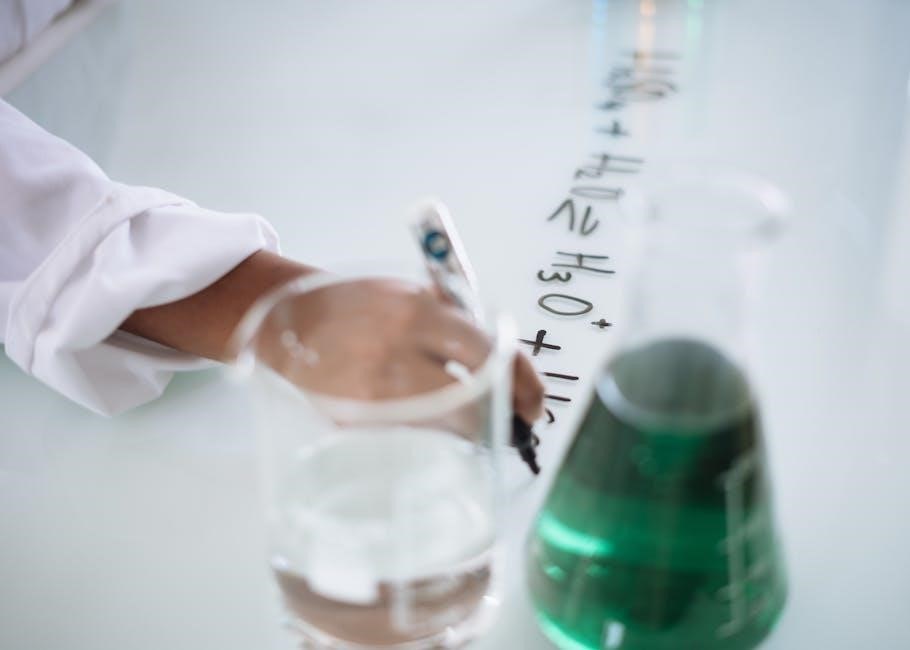
Effective data interpretation and clear report writing are vital skills. Students will learn error analysis‚ significant figures‚ graphing techniques‚ and drawing valid conclusions from experimental results.
Experiment 16: Error Analysis and Significant Figures
This experiment focuses on understanding and quantifying errors inherent in all measurements. Students will differentiate between random and systematic errors‚ calculating percent error and assessing data precision. A core component involves mastering significant figure rules for calculations‚ ensuring appropriate representation of experimental uncertainty. The lab emphasizes the importance of acknowledging limitations and accurately reporting results‚ crucial for scientific integrity. Participants will analyze data sets‚ identify potential error sources‚ and propagate uncertainties through calculations‚ developing critical evaluation skills essential for future scientific endeavors.
Experiment 17: Graphing and Data Interpretation
This lab centers on visually representing experimental data through effective graphing techniques; Students will learn to select appropriate graph types – scatter plots‚ line graphs‚ and bar charts – based on data characteristics. The exercise emphasizes proper axis labeling‚ scaling‚ and the determination of trends and relationships within the data. Participants will practice interpreting graphs to draw meaningful conclusions‚ identifying correlations and potential outliers. Furthermore‚ the experiment reinforces the connection between graphical representation and underlying chemical principles‚ fostering analytical skills.
Appendix
This section provides essential reference materials‚ including solubility rules‚ conversion factors‚ the periodic table‚ and a detailed guide for proper lab report formatting.
Experiment 18: Common Chemical Reagents
This experiment details frequently used chemicals in general chemistry labs‚ emphasizing safe handling and proper identification. Students will explore reagents like acids (hydrochloric‚ sulfuric)‚ bases (sodium hydroxide‚ ammonia)‚ and common salts (sodium chloride‚ potassium nitrate).
The focus is on understanding their properties‚ hazards‚ and appropriate storage methods. Detailed information regarding concentration calculations and dilution techniques will also be provided. Furthermore‚ students will learn about potential reactions and incompatibilities between these reagents‚ reinforcing safe laboratory practices and responsible chemical management.
Experiment 19: Solubility Rules
This experiment introduces fundamental solubility rules‚ predicting whether ionic compounds will dissolve or form precipitates in water. Students will investigate the solubility of various salts‚ applying established guidelines to determine potential product formation during reactions.
The lab emphasizes the importance of these rules in predicting reaction outcomes and understanding aqueous solution behavior. Practical exercises involve mixing solutions and observing precipitate formation‚ validating theoretical predictions. Detailed solubility charts will be provided‚ aiding in accurate analysis and fostering a strong grasp of these essential chemical principles.
Experiment 20: Periodic Table of Elements
This experiment focuses on utilizing the periodic table to predict chemical properties and trends. Students will analyze element groups‚ identifying patterns in atomic size‚ ionization energy‚ and electronegativity. The lab involves predicting reactivity based on periodic trends and relating these to observed chemical behaviors.
Activities include identifying metals‚ nonmetals‚ and metalloids‚ and predicting the formulas of simple ionic compounds. A comprehensive periodic table will be provided‚ serving as a crucial reference tool. This reinforces understanding of elemental organization and its impact on chemical interactions.
Experiment 21: Conversion Factors
This lab emphasizes the critical skill of dimensional analysis using conversion factors. Students will practice converting between various units of measurement – mass‚ volume‚ temperature‚ and length – within the metric and English systems. The focus is on setting up conversion problems correctly to ensure accurate calculations.
Exercises include converting between grams and kilograms‚ Celsius and Fahrenheit‚ and inches and centimeters. A provided list of common conversion factors will be utilized. This experiment builds a foundation for stoichiometric calculations and data analysis in subsequent experiments‚ promoting precision.
Experiment 22: Lab Report Format
This experiment doesn’t involve a traditional chemical reaction‚ but focuses on proper scientific documentation. Students will learn the standardized format for a general chemistry lab report‚ including title‚ abstract‚ introduction‚ procedure‚ data‚ results‚ and conclusion. Emphasis is placed on clear‚ concise writing and accurate data presentation.
Reports will be graded on organization‚ clarity‚ and adherence to the specified format. Understanding this structure is crucial for effectively communicating experimental findings. The goal is to prepare students for future scientific writing endeavors‚ ensuring professionalism and reproducibility.
Experiment 23: Waste Disposal Procedures
This crucial experiment focuses entirely on responsible chemical waste management within the lab environment. Students will learn to correctly identify‚ segregate‚ and dispose of various chemical substances‚ adhering to strict safety and environmental regulations. Detailed instructions will cover acid/base neutralization‚ organic solvent disposal‚ and heavy metal waste handling.
Proper disposal prevents environmental contamination and ensures lab safety. Emphasis will be placed on understanding waste stream classifications and utilizing designated containers. Successful completion demonstrates a commitment to ethical and sustainable laboratory practices‚ vital for all chemists.